Pumpkin chunkin and hurling is about as simple as a sport gets. You build a machine, load a pumpkin, and throw it as far as it will go. The best machines in the world can send one more than a mile.
It’s a silly idea that people chase with real engineering. Some teams spend years and thousands of dollars on air cannons and steel trebuchets. Others knock together a backyard catapult in a weekend and call it good. Here in the Snohomish Valley we held our own pumpkin hurl for years, so we’ve got a soft spot for it. This guide covers where the sport came from, the records, how the machines work, and where you can still watch pumpkins fly in the Pacific Northwest.
In this guide
What is pumpkin chunkin and hurling?
It’s the same sport under a few different names. “Punkin chunkin” is what they called it in Delaware, where the modern contests started, and the spelling stuck. “Pumpkin hurling” or a “pumpkin hurl” is common for events built around trebuchets and catapults, which is what we called ours in Snohomish. You’ll also see pumpkin launching, pumpkin chucking and pumpkin tossing. They all mean throwing a pumpkin with a machine.
What you’ll actually find falls into two camps:
- Distance competitions. Teams bring homebuilt machines and compete in classes. Every throw gets measured, and the longest one wins. This is the serious version.
- Farm attractions. A pumpkin patch sets up a cannon or giant slingshot and lets visitors fire at a target, usually an old car or a painted barrel. Nobody’s measuring, and everybody’s having fun. This is where most people in the Northwest get to try it.
A short history of pumpkin chunkin and hurling
First came the siege engines
Long before anyone threw a pumpkin, people were throwing rocks at castle walls. The word catapult comes from Greek, and it roughly means “shield piercer.” Early versions were giant crossbows that fired bolts and stones. The trebuchet came later. Crews in ancient China were pulling down on ropes to swing a throwing arm as early as the 4th century BC. By the 12th century, engineers in the Mediterranean and Europe had swapped the crew for a heavy counterweight. That made the trebuchet the most powerful siege weapon in the world until gunpowder took over.
The most famous one was probably Warwolf, a massive trebuchet King Edward I of England built during the siege of Stirling Castle in Scotland in 1304. The story goes that the Scots tried to surrender before it was finished, and Edward made them wait until he’d had a chance to try it out.
Delaware, 1986
The modern sport began in Sussex County, Delaware, in 1986. A group of friends got to arguing about who could throw a pumpkin the farthest, and the argument turned into a contest. The Melson-Thompson team won that first year with a throw of 178 feet. Today, a decent backyard catapult can beat that.
That little contest became the World Championship Punkin Chunkin. It started in Lewes, kept outgrowing its fields, and in 2007 moved to farmland near Bridgeville. That year it drew more than 20,000 spectators and about 75 teams and brought in more than $800,000, with over 70 percent going to local community organizations. Charity was always part of the deal.
Pumpkins on TV
Television helped make it famous. The Discovery Channel aired its first Punkin Chunkin special in 2002, and the Science Channel covered the World Championship every year from 2009 to 2016. MythBusters hosts Adam Savage and Jamie Hyneman hosted in 2010, and Tory Belleci, Kari Byron and Grant Imahara took over from 2011 to 2013. For a lot of families, watching pumpkins fly over a Delaware field became a Thanksgiving tradition.
The 2016 accident and what came after
The championship was already struggling with insurance, and in 2015 it was canceled when insurers refused to cover it. It came back in 2016, and during taping an air cannon malfunctioned. Flying metal struck a member of the TV production crew in the head and seriously injured her. The Science Channel stopped filming and never aired that year’s special.
The lawsuit that followed ended the Delaware era. There was no championship in 2017 or 2018. In 2019 it moved to the old Chanute Air Force Base in Rantoul, Illinois, and in 2023 a licensed World Championship was held in a field outside Vinita, Oklahoma. As far as we can tell, there hasn’t been one since.
The sport spreads
The big championship may be on hold, but the idea got loose a long time ago. Belgium has hosted a European championship since 2004. Olean, New York, runs the Great Pumpkin Shoot, where accuracy counts more than distance. Towns, farms, schools and Scout troops all over North America hold their own contests every fall. And in 2008, the Snohomish Valley got one too.
Pumpkin chunkin world records
The Guinness World Record for the farthest pumpkin throw belongs to an air cannon called Big 10 Inch. On September 9, 2010, in Moab, Utah, it fired a pumpkin 5,545.43 feet, or about 1,690 meters. That’s just over a mile. The high desert helped. Moab sits around 4,000 feet up, and thinner, drier air means less drag on a flying pumpkin.
The World Championship kept its own records by class, and the top mark there is 4,694.68 feet, set by the air cannon American Chunker in Bridgeville, Delaware, on November 1, 2013. Here are some of the championship records for each type of machine:
| Class | Team | Distance | Year |
|---|---|---|---|
| Air cannon | American Chunker | 4,694.68 ft | 2013 |
| Female air cannon | Hormone Blaster | 4,382.96 ft | 2013 |
| Catapult | Chunk Norris | 4,091 ft | 2019 |
| Torsion | ETHOS | 3,792 ft | 2019 |
| Trebuchet | Colossal Thunder | 3,377 ft | 2019 |
| Centrifugal | Bad To The Bone | 3,245.58 ft | 2013 |
| Human powered | Shooda Noed Beter | 2,343.42 ft | 2016 |
| Youth air cannon | Snot Rocket | 4,206.32 ft | 2013 |
For comparison, the trebuchets at our own Snohomish Pumpkin Hurl were throwing about half a mile by 2013. Not bad for a farm field on Ebey Island.
The machines behind pumpkin chunkin and hurling
Competitions split machines into classes, because an air cannon and a wooden catapult aren’t really playing the same game. The World Championship had more than a dozen divisions, including youth classes and a “theatrical” class decided by crowd vote. Here are the main types.
Air cannons
An air cannon fills a big tank with compressed air and dumps it all at once behind the pumpkin, which sits in a long barrel. They hold every distance record by a wide margin. They’re also the most dangerous machines in the sport, because a tank under that much pressure stores a lot of energy. Most of the pumpkin cannons you’ll see at farms are small, low-pressure versions of the same idea.
Trebuchets
A trebuchet uses a heavy counterweight on the short end of a long arm. When the weight drops, it whips the arm and a sling around, and the pumpkin lets go near the top of the swing. This is the medieval siege engine, and it’s the crowd favorite because you can see exactly how it works. Most of the teams at the Snohomish Pumpkin Hurl brought trebuchets.
Catapults
In chunkin terms, a catapult stores energy by stretching something, like springs, bungee cords, rubber or rope, and lets the arm snap forward. Big competition catapults are no joke. The record holder threw a pumpkin more than 4,000 feet.
Torsion machines
Torsion machines store energy by twisting bundles of rope or cable, the way Roman siege engines did. When the twist unwinds, the arm swings.
Centrifugal and human-powered machines
Centrifugal machines spin an arm faster and faster and let the pumpkin go at just the right moment. Human-powered machines can’t store any energy ahead of time, so every bit of the throw comes from the team’s muscles during the launch. Getting a pumpkin past 2,000 feet that way is impressive.
How a trebuchet throws a pumpkin
A trebuchet is really just a seesaw with a lopsided design. Here’s what happens in the second or two after the crew pulls the trigger:
- The counterweight falls. All the energy comes from gravity. The crew cranked that heavy weight up into the air, and now it drops.
- The long arm whips up. Because the pivot sits much closer to the weight, a short drop on one end becomes a long, fast swing on the other.
- The sling adds reach. The pumpkin rides in a sling hanging off the end of the arm. As the arm swings, the sling swings out even faster, which acts like making the arm longer. That’s why a trebuchet out-throws a simple catapult of the same size.
- The pumpkin lets go. One end of the sling is attached to a hook or pin. At the right point in the swing it slips free, the sling opens, and the pumpkin flies. Adjusting that release point is where teams win or lose.
Picking the right pumpkin for chunkin
A pumpkin that bursts in the air doesn’t count. Competitors call that “pie,” and under championship rules it’s disqualified. A pumpkin has to stay whole from the moment it leaves the machine until it hits the ground.
So chunkers look for pumpkins with thick, hard rinds that can survive a violent launch. White varieties like Casper and Lumina, and a variety called La Estrella, are popular for exactly that reason. Contests set their own weight rules. At our Snohomish Hurl, the trebuchets threw 8-pound pumpkins. Size, shape and how round the pumpkin is all affect how it flies, so serious teams pick through a lot of pumpkins to find their ammunition.
If you’re picking pumpkins for eating or carving instead, we have a guide to picking a pumpkin that lasts until Halloween.
How a throw gets measured
When a pumpkin is landing nearly a mile away, nobody’s walking out with a tape measure. At the World Championship, spotters on ATVs found where each pumpkin hit and marked the spot with color-coded spray paint. A professional surveyor then worked out the distance from GPS coordinates. Teams got one shot a day over three days, and only the longest throw counted.
Smaller contests keep it simpler, with a measuring wheel, a laser rangefinder, or flags set out along the field.
Why schools and 4-H clubs love it
Ask a team why their throw came up short and you’ll get an answer about release angle, arm ratio, sling length or air pressure. Pumpkin chunkin is a physics lesson you can watch, which is why engineering students, high school teams and 4-H clubs build machines every fall. A 4-H team from Lynnwood brought a 12-foot trebuchet to the Snohomish Pumpkin Hurl in 2015, and the students did all of the building and welding themselves. It’s physics class, except you get to throw a pumpkin at the end.
Our own: the Snohomish Pumpkin Hurl
From 2008 into the mid-2010s, the Snohomish Festival of Pumpkins kicked off every September with the Snohomish Pumpkin Hurl at Alexander Farm on Ebey Island, between Everett and Snohomish. Teams brought homebuilt trebuchets and catapults and flung 8-pound pumpkins across the field.
The competitors were a mix of serious and wonderful. Squash-O-Fire, a crew from Sedro-Woolley, spent four months building a 14-foot trebuchet and came into 2012 as the defending champion. That same year an 11-year-old from Mukilteo entered a 5-foot trebuchet he’d built for a class project. As fewer teams showed up with machines, the organizers built a medieval faire around the contest, with jousting knights, Viking shield walls and black powder cannons.
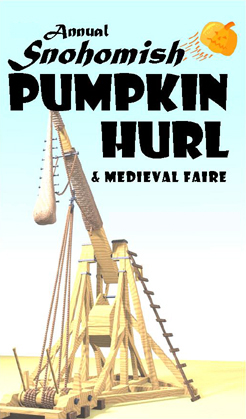
We’ve written up the whole story, with names, years and photos: The Snohomish Pumpkin Hurl & Medieval Faire.
Where to see pumpkin chunkin and hurling in the Pacific Northwest
Big trebuchet competitions have gotten rare around here. Ours on Ebey Island is gone, and so is the Pumpkin Pitch that used to be part of the Burlington Harvest Festival in Skagit County. But plenty of Northwest farms still fire pumpkins and apples out of cannons and giant slingshots every October, and you can often take a turn yourself.
One important note. Farm attractions change from year to year, and some are only on weekends or need an activity ticket. Everything below was current as of the 2025 or 2026 season unless we say otherwise, but please check the farm’s website before you drive out.
Washington
- Thompson’s Farm, Naches. The biggest pumpkin cannons we know of in the state. Fourth-generation farmer John Thompson built them himself, and they’ve been reported throwing pumpkins as far as three-quarters of a mile. They fire on the hour from 10 a.m. to 4 p.m. on October weekends, and admission and parking are free. It’s west of Yakima at 9535 Old Naches Highway. thompsonsfarm.com
- Carleton Farm, Lake Stevens. One of our own festival farms. Carleton runs two pumpkin cannons that send pumpkins out over the fields, plus apple cannons on the activity ticket. Farm details
- Thomas Family Farm, Snohomish. Apple cannons are on the list of activities, along with the night maze and haunted trail later in the season. Farm details
- Craven Farm, Snohomish. Craven has an apple slinger, and entry to the farm is free. Farm details
- Double R Farms, Puyallup. Three pumpkin slingshots, including one just for kids.
- Spooner Farms, Puyallup. Pumpkin slingshots at the Fall Festival.
- Picha Farms, Puyallup. A slingshot the farm calls the best in the Puyallup Valley. We’ll let you be the judge.
- Oxbow Farm, Carnation. A pumpkin slingshot during the farm’s Oxtober Fall Festival.
- Thomasson Family Farm, Enumclaw. An apple slingshot on weekends.
Oregon
- Heiser Farms, Dayton. Home of the Pumpkin Cannon Demolition Derby, where air cannons fire pumpkins at old cars and barrels. It’s a fall tradition at the farm, and it was back again in both 2025 and 2026. heiserfarms.com
- Pumpkin Chunkin’, Baker City. This one’s different. Instead of a machine, you throw pumpkins at a target from a helicopter. The 11th annual event was held on October 18, 2025, at Baker Aircraft. Rides were $50, only 400 tickets were sold, and they usually sell out fast. It raises money for the Spc. Mabry James Anders Memorial Foundation, which has given more than $215,000 in scholarships to local students since 2016.
- Detering Orchards, Harrisburg. An apple blaster cannon during the farm’s Apple Daze events, between Eugene and Corvallis.
- Fort Vannoy Farms, Grants Pass. The farm’s fall festival has featured the Pumpkin Chunker, a cannon you aim yourself at a broken-down old vehicle. We couldn’t confirm it for this season, so call ahead.
Idaho
- North Idaho College, Coeur d’Alene. In November 2025 the college’s Engineering Club rolled out a trebuchet and hurled dozens of pumpkins across a campus parking lot. Attendance was about four times bigger than the year before, so it looks like it’s catching on.
Keep an eye out for
College engineering clubs, high school physics classes, 4-H groups and Scout troops around the region hold pumpkin launches every fall, and they rarely get much publicity. Check campus and community calendars in October and early November. And if you know of a pumpkin chunkin or hurling event in Washington, Oregon, Idaho or British Columbia that we missed, tell us about it and we’ll add it.
How to build a small pumpkin catapult at home
You don’t need a 14-foot trebuchet to have fun. A small tension catapult that lobs mini pumpkins across the backyard is a good weekend project with kids. Here’s the general idea.
What you’ll need: sturdy lumber (2x4s work well), a few hinges, wood screws, heavy bungee cords or surgical tubing, a small bucket or cup for the pumpkin, a drill, a saw, a tape measure and safety glasses.
- Build a base. Make a rectangular frame about 3 feet long and 2 feet wide. Wide matters, because a narrow base will tip when the arm fires.
- Add the uprights. Attach two vertical boards near the front of the frame and brace them back to the base in an A shape so they don’t wobble.
- Mount the arm. Attach a long board as the throwing arm so it pivots at the bottom of the frame, and fasten the cup to the far end.
- Add the power. Run bungee cords or tubing from the arm to the front of the frame. Pull the arm back and they stretch. Let go and they snap it forward.
- Add a stop. Put a padded crossbar across the uprights for the arm to hit. That sudden stop is what flings the pumpkin out of the cup.
- Test without a pumpkin. Pull it back a little at a time and make sure everything holds before you load anything.
- Launch. Use mini pumpkins or small gourds. Everyone stands behind and to the side of the machine, never in front.
Want to experiment? Try changing one thing at a time, like the angle of the stop bar or the number of bungee cords, and measure each throw. You’ll learn more physics in an afternoon than in a week of worksheets.
Safety, seriously
These machines store a lot of energy, and things break. Organized events keep spectators well back from the firing line and inspect machines before they launch. The 2016 accident in Delaware is the reminder nobody in the sport wants to repeat.
- Wear safety glasses while you build and while you launch.
- Fire into an open area, away from people, pets, cars and windows.
- An adult should do the loading and releasing.
- Never build anything that uses compressed air or pressure tanks unless you really know what you’re doing. Leave the cannons to the farms.
- At farm attractions, follow the staff. They run those cannons all season and know where the pumpkins land.
Pumpkin chunkin and hurling: common questions
What’s the difference between pumpkin chunkin and pumpkin hurling?
Mostly the name. “Punkin chunkin” comes from the Delaware contests where the sport started. “Pumpkin hurling” tends to be used for trebuchet and catapult events. Both mean launching a pumpkin with a machine.
What’s the world record for throwing a pumpkin?
The Guinness World Record is 5,545.43 feet (about 1,690 meters), set by the air cannon Big 10 Inch in Moab, Utah, on September 9, 2010. The World Championship Punkin Chunkin record is 4,694.68 feet, set by American Chunker in 2013.
Is the World Championship Punkin Chunkin still held?
Not regularly. After the 2016 accident in Delaware it was off for two years, held in Illinois in 2019, and held in Oklahoma in 2023. We haven’t seen a championship since then, but local contests are going strong.
Where can I see pumpkin chunkin in Washington?
Thompson’s Farm in Naches fires big pumpkin cannons on the hour on October weekends. Closer to Seattle, Carleton Farm in Lake Stevens has pumpkin cannons, and several farms in Snohomish, Puyallup, Carnation and Enumclaw run apple cannons or pumpkin slingshots. See our list above.
What kind of pumpkin flies best?
One with a thick, hard rind that won’t burst on launch. White varieties like Casper and Lumina are popular with competitors, along with La Estrella. A round, even pumpkin flies straighter than a lumpy one.
How far can a homemade trebuchet throw a pumpkin?
Small student and hobby trebuchets usually throw somewhere between 50 and a few hundred feet. Competition trebuchets are a different animal. The championship record is 3,377 feet.
Is a trebuchet a catapult?
In everyday speech, yes, a trebuchet is a kind of catapult. In pumpkin chunkin they’re separate classes. A trebuchet is powered by a falling counterweight, while a competition catapult is powered by tension, like springs or bungee cords.
Go see some pumpkins fly
Pumpkin chunkin and hurling started as an argument between friends and turned into a sport with world records, TV specials and a lot of homemade machines. You don’t have to drive to Delaware to see it. Pick a farm from the list above, bring boots, and line up for a turn at the cannon. If you’re planning a day in the Snohomish Valley, start with our farms page and Plan Your Visit.
Sources: Guinness World Records; Punkin chunkin on Wikipedia (championship history and class records); The Old Farmer’s Almanac; Everett Herald coverage of the Snohomish Pumpkin Hurl, 2012 to 2015; Seattle’s Child 2026 pumpkin patch guide; Thompson’s Farm; KPTV on Heiser Farms; Go Eastern Oregon on Baker City’s Pumpkin Chunkin’; The NIC Sentinel; Willamette Valley Visitors Association. Spot something out of date? Let us know.